I got very into movies again at the end of the month so I have an exceptional amount to talk about this time around! A bunch were crime pieces which I really enjoyed, mostly classics of the genre that I just never got around to: The Godfather, Goodfellas and Heat, plus, I watched The Room (spoilers: I had a fuckton of fun watching it), All About Lily Chou Chou (I had much less fun watching it) and Sacco And Vanzetti (which catapulted itself into being an all time favourite). Much to speak of, so I'll waste no further time.
The Godfather
The Movie, really. It is The Movie, the one. One of those timeless classics everyone knows even if they haven't watched it in full that has infiltrated the very fabric of our contemporary social existence.. and the reason it has done this is because it is very, very good. I am not about to be a contrarian here, it really is as good as they say.
The aspects, as tends to be the case with crime fiction, that I found most interesting, were the moral negations, the ways in which the rules of the game fundamentally alter as far as it relates to people in the game, people fundamentally being unable to maintain any sort of peace regardless of the rules, regardless of how "civilians" aren't meant to get caught up. Michael Corleone was never supposed to be part of the mob, and yet he was, driven to the lengths that he was because people wanted to hurt his father and he felt offended and like he had an obligation towards something greater. It is evident, really, that Michael always had it in him, and it is especially evident that he took to things well, eventually developing the cold ruthless inclination required of a don, avenging his brother and the attempted murder of his father but losing out on any chance to remain innocent or kind in the process. It is grim.
The Godfather readily describes the moral decay and the fact that, really, the mob is not that much different from capitalism. The social critique is rather prevalent considering the fact that quite a few mob members express racist sentiments throughout, and in the end, what that life represents is a more honest formulation of what capitalism already is, brutal and requiring the complete destruction of all conscience in the name of power consolidation. Michael Corleone, probably after the death of his first wife, understood this perfectly and was hardened as can be and the final shot of him and Kay ultimately being separated by the veneer of business further still adds to the continuing allegory of what this all means.
Besides all that.. The Godfather is really good! Like.. really, really good. Like, it's a fantastic very compelling watch front to back that manages to keep you hooked to the action and the suspense all throughout. I also loved the depictions of violence and how unforgiving they all are, the way Luca Brasi gets choked, Sonny getting shot, etc, and it has a timeless aesthetic. There's very little new that could really be said about The Godfather, so I'll cut it here by saying I really liked it.
Heat
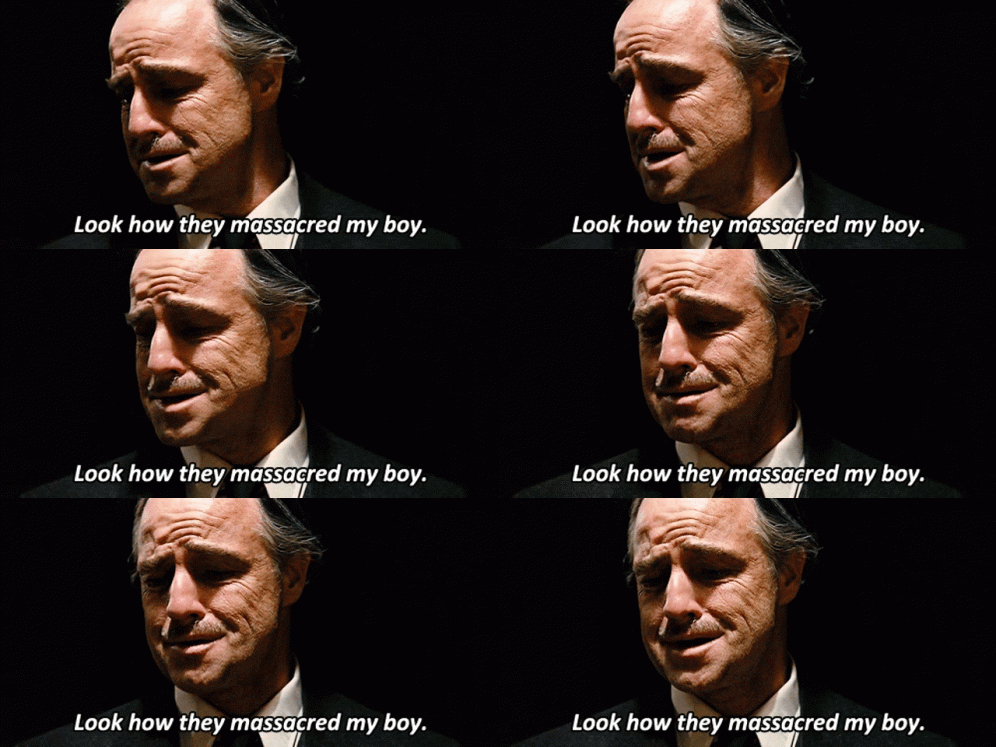
GIMME ALL YOU GOT!!!
Al Pacino as Vincent in this movie is the best. He is the absolute best. Heat is the perfect action thriller front to back, a movie that is driven towards a sort of similar moral destruction as The Godfather, but what it takes on is a more modernistic stylised lens, one that is captivating because of the writing, the characters, it looks so good and it flows so good, it is a marvel of cinema. De Niro gives a sort of opposite performance as Neil to Pacino's Vincent, he is calm where Vincent tends to be a lot more erratic and eccentric, and it works quite well because they are at a perpetual equal playing field. It, of course, equalizes these two and their struggles, presenting them both as madmen who don't know how to do anything but be mad, finding a sort of Homeric glory in their ability to pursue the end of catching the crew or pulling off the score. They like each other but they are kindred spirits, two sides of one all destructive coin that cannot fathom the existence of other coins.
The complete destruction of the social lives of all these men is riveting. Chris' marriage falls apart and he escapes capture but he is forever separated from his wife, Michael flat out dies in one of the most shocking scenes of the entire movie for me after picking up a child as effectively as a body shield and even more than both of these things, one of my favourite parts of the movie was the subplot of Don Breedan, a perfect encapsulation of how much of an ouroboros the entire enterprise of crime and punishment is, one that never allows anyone to move on because Don was on the up and up, as is reflected by the fact that in the amazing back-to-back-to-back scene of first Vincent, then him, then Neil all engaging with their particular partners, his relationship is by far the most healthy, and yet he throws it all away because he feels completely disrespected by the system. Neil knew him in prison and treated him as a partner and as an equal and this was all it took for him to be willing to plunge himself to his doom.
Every aspect of Heat is a marvel down to how every plot threat is resolved and everything connects back together into a beautiful crescendo wherein Neil ends up dying in the pursuit of the primal life that he'd always wanted to lead. It has a sort of beautiful fatalism to it that really captured my imagination. Much love.
Goodfellas
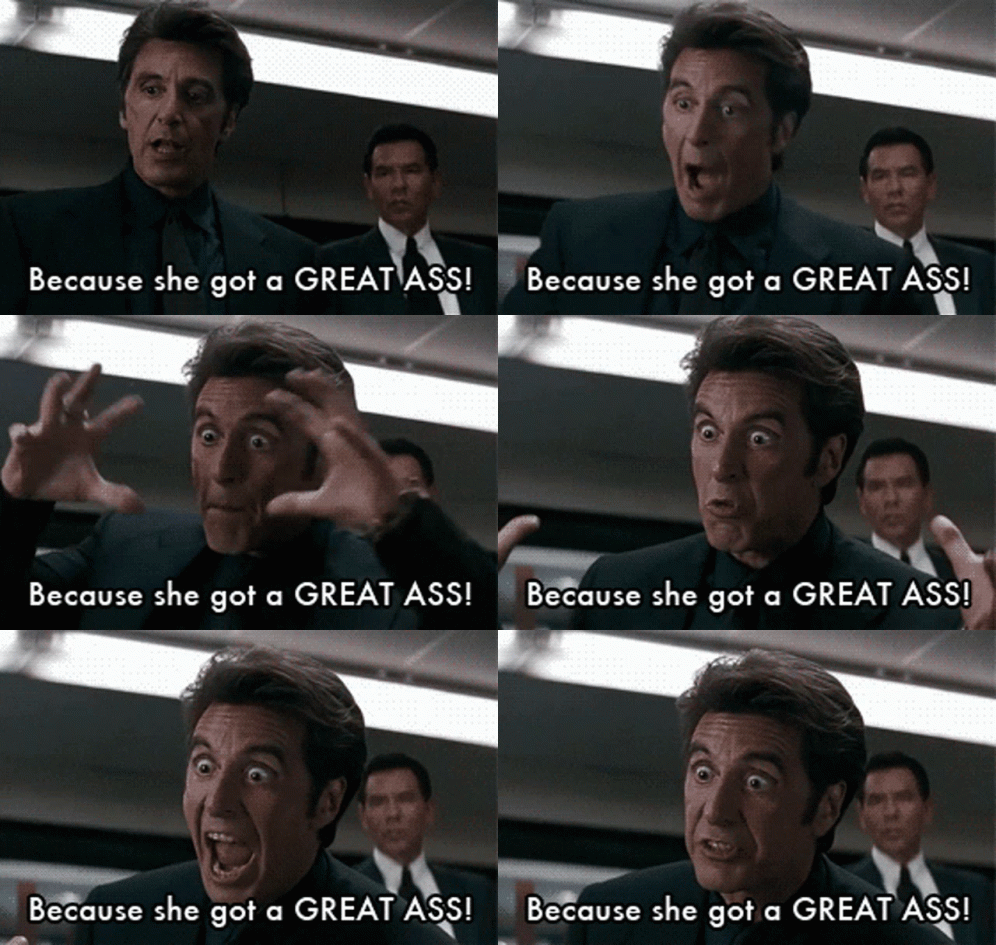
Henry Hill meets the ultimate demise that comes at the end of living a putrid way of life, one that made him overlook and partake in the debauchery and cruelty of evil men, ones who he always saw as more affluent and successful than the bum of a father he had, one who beat him continuously because he could not cope with modernity and his son's lack of respect for it and for the vanity of conventional values, instead finding in Paulie and Jimmy infinitely more substance, the sort that validates him and his wants for a better life that doesn't involve mopping the floor. Nevertheless, the path ventured is one that costs him much, the lives of his friends (either killed or in prison), his marriage and his chance at ever living the sort of life he initially wanted.
People who argue this movie glorifies crime don't understand what it's getting at because the terror is everpresent, it just so happens to be the case that the movie is presented in a sort of montage-way that is immensely satisfying to watch in that Hollywood way, somewhat similar to City Of God, a similarly brilliant crime-centric film. Excited to see what else Scorsese has to offer!
All About Lily Chou-Chou
I do not like this movie. It irritates me quite greatly for many reasons. Chief among them is the general insistence of this movie to focus far more on aesthetics, mood evocation, rather than actually having any major substantive point. I will admit to having watched it in a state of mild delirium, but I have to say that there are so many aspects of it which I find confounding, so many odd and unjustified narrative choices, no real grand point to it all and a very dubious conclusion.
More specifically, I suppose I would say that I find the approach the movie takes as it relates to childhood trauma is not particularly nuanced, it handles all these themes with a sort of shock-value centric lens that is grating, one that manages more so to just feel ass though it wants to come off more deep than it actually is. I suppose that this could all be shortened into a conundrum: what is this movie about? I couldn't answer you if you asked me.
I suppose it's about teenage obsession, about betrayal and broken promises and being violated and many other things, but it also just goes for all of these things in a way that comes off so absurdly tactless that I couldn't tell you what it all means, what you're supposed to gleam from any of it, what you're supposed to conclude. It's incredibly irritating and I find myself coming with a sort of real irritation. I said this in my Letterboxd review, but I find it incredibly apt that an artist like Parannoul took to this so well that he made a still from it into an album cover. I suppose it hits at the same sort of core for a lot of people, but I find it illuminating to my own continuous oppositions to what come off like dense views of what constitutes good art. It feels like a vain attempt to connect to the general angst of a younger self that I find myself in continual opposition to, a sort of melancholy of being I cannot take on and one that feels like a pebble in my shoe whenever I do engage with it. I wouldn't judge anyone for liking this movie, it does pull off its own aesthetics very well, but in most regards I find it rather impossible to relate to or connect with most of the experiences on display or the way they're evoked.
The Room
Oh, man. What do you even say. I love this movie so damn much.
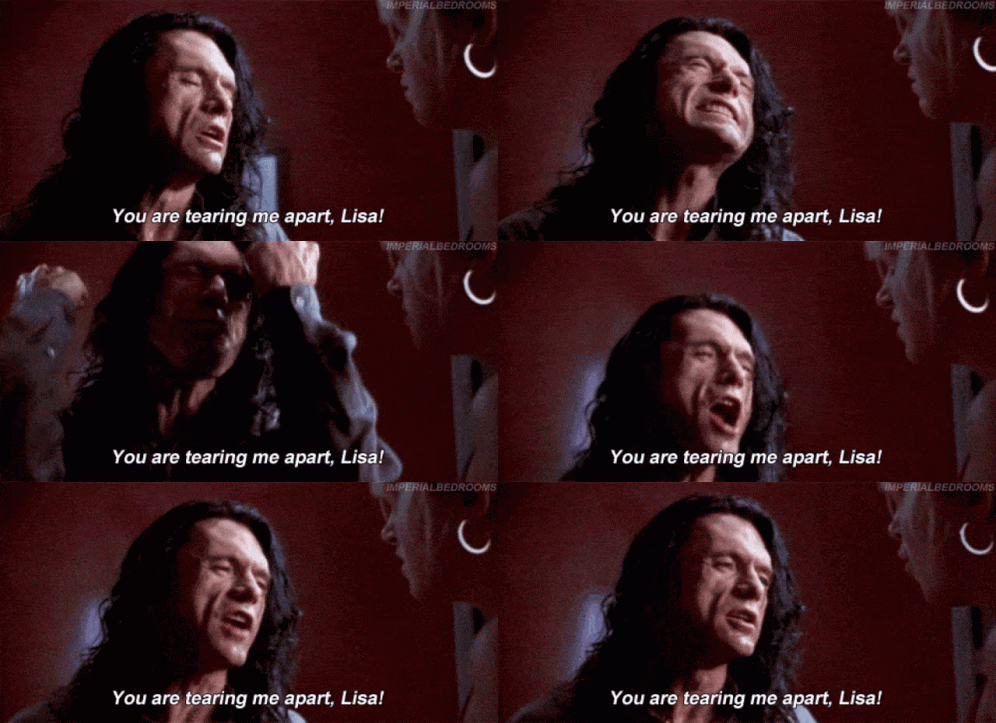
It was an absolute blast to watch. Such a surrealist, difficult, terrible, accidentally brilliant thing it is, such a beautiful testament to what ego can bring about, a sort of rotting beauty of hubris that stinks like a dog that just pooped itself, mind you, but a beauty nonetheless. This movie is terrible by all traditional estimations but I found in it a really amazing, amusing sort of escape. Of course, there is unintentional depth to be had in analyzing it in the appropriately post-modernistic context it requires, one that really elaborates very deeply on the megalomaniacal bent that Wiseau needed in order to get to a point where he can make such a.. disruptive work.
There are so many strange things about this movie. Why are there so many deeply awkward entirely unarousing sex scenes with the cheesiest possible music on top again and again? Why does Mark almost kill Peter and the latter just almost immediately forgives him and seems more annoyed about Mark smoking pot than the attempted homicide? What the fuck is that ending? Why does Lisa's mom just randomly say she has breast cancer and then that never gets brought up again? What about Denny and the drug dealer? Where IS his fucking money, Denny? Why does this also just flat out not connect back to the greater plot? Why does everyone in this movie talk so fucking weird? Why does Johnny immediately ask Mark about his sex life at the cafe without any sort of tact? Why do people rehash the exact same conversations over and over again? It's all so amazingly captivating to watch in the same way that a car crash is, but unlike car crashes, I can admire the grim sort of profundity that such a work envokes, one wherein the madness of the artist supercedes the art, one wherein said madness results in the creation of a limping product of creative incest, one that is impossible to really take your eyes off of.
I suppose it has the same sort of appeal as watching Trump does. It's a bizarre unaware self-parody and it is transfixing in those things, and you know that it's very bad and you really shouldn't like or find it funny, and you don't, when you really look at it, but it's still too stupid to not charm or be funny on some level. All the love
Sacco And Vanzetti
This catapulted it's way into becoming one of my favourite movies very quickly. It was a harrowing and beautiful watch all in one, one that really helped strengthen my personal convictions and really strengthen my will towards what it means to be convicted, both in the legal sense and in the sense of having a conviction, one that helped to really strengthen my commitment to my anarchist values and the two titular men have since then really become idols to me.
I think the point of the movie can really be expressed in what Bart in particular says, at differing times. After the entire jury proclaims them guilty of this murder without exception, Nicola speaks of not wanting to die, of wanting to live and not be a political martyr. Bart responds with the sobering statement: "I want to live, but in another world."
I think that explains more aptly than anything the general sentiment this brilliant work of art carries with itself, one of knowing that it doesn't have to be like this but it is and there's very little to do other than cope with the brutality, cruelty, freezing cold heart of the world and of the God that has neglected to look upon our tiny, pathetic little bodies. It's a really evocative movie and one that had me very emotional for almost its entire runtime because in Bart and Nicola, one finds the spirit of resilience and courage and the willingness to endure the hardship of life and to fight against the systemic oppression of their noble values, ones that refuse to acknowledge authority by nature and ones that offend the system so much that it sees fit to discriminate against them, for that and for their heritage and for their class, things out of their control. It is a permanently relevant film and tale, further still. The struggle for oppression will forever provide meaning to the lives of poor peasant boys, as Bart himself puts it, and people will forever find themselves utterly disgusted with the systemic oppression and continual destruction of the hopes and dreams of good people, of those who have relevant things to live for.
It makes me feel a sort of pride in being an anarchist. I see my continued existence as being a sort of offense towards many, that I am a dissident ipso facto of a lot of my personal traits. I am a genderqueer pansexual traditionally irreligious Arab, one that sees in the world and in his culture a continuous tendency towards conformity, towards the general tendency of rejecting all things different and interesting and genuine in favor of the well known platitudes of dawah men. It's so dull. This, it isn't. It's a thing to live for, one I'd be proud to continue existing for, one I hope to aid properly, eventually. Stay rebellious.