Post-Punk And The Death Inside
There is a prevalent sense of doom in much of goth music. It's incredibly prevalent in the music of Bauhaus, in Nick Cave's early work, in The Cure's output until Pornography. There is a sense in which these bands were making music for a generation that in many ways did not think that the world should exist as it is, that felt a consistent discord between their souls and what was around and what the world wanted to make of them all. This is also very prevalent in the case I want to examine most thoroughly here: Joy Division.
Lately, I watched the Control biopic and I didn't include it in my monthly write-up last month because I wanted to dedicate an entire section to it. It is, for the record, a brilliantly well-made film, something that in many ways reflects all of these realities as perfectly as can possibly be hoped for. It's shot in beautiful black and white that helps to affirm the death-inside of Ian Curtis all throughout, and really, Control is mostly focused on Ian first and foremost, and of course this is to be expected. Ian Curtis is one of the big inclusions in the tradition of the depressive rockstar, the one whose time is fleeting and who came down to earth sent by some otherworldly vengeance of angst to tell us all how putrid our beings are, people who never get the guide that takes them by the hand. They become the guides of others, strangely enough. I want it to make something abundantly clear: I adore Joy Division. Ian Curtis was one of the best lyricists of his generation and the entire band was on point in every aspect of their musicality; Sumner's guitar and synth work added to the feeling that the corpse was still warm; Peter Hook's bass playing was the writhing around before death; Morris' drumming the bullets. Curtis, then, was the narrator of this horrific tale, and in so many ways his life and his music reflect a sense of the world that is perturbing specifically because of everything that it represents. I am here to argue that Ian's depiction in Control reflects one thing first and foremost: toxic masculinity.
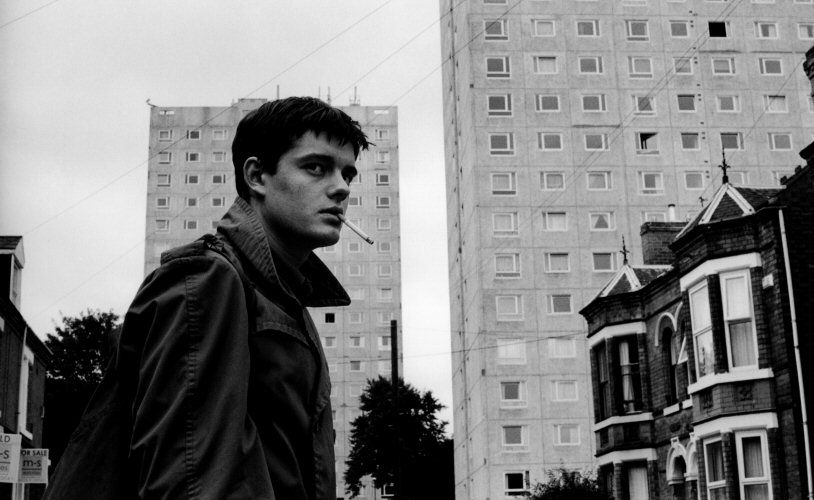
The ways in which this reflects itself are incredibly obvious in most facets of the movie. Ian is entirely incapable of really communicating his emotions to anyone and he keeps tumbling down this rabbit hole of bad decisions between cheating on Debby and refusing to perform causing the riot and all the like, and further more, it is rather evident that there is no real support system for him; his bandmates and his manager and Tony Wilson, all of them march on gesturing at the same things: Joy Division are taking over the world. And it is rather evident, further still, that he does find solace in his art in particular, in the words of the English language in how he writes and the feelings all his lyrics so evidently reflect. He's left a mark on the world that no one could ever deny, especially on musical culture and history, but nevertheless, such things very obviously could not be seen and may not have mattered to his tortured mind.
There are, alas, some glaring issues here. For one, it's evident that one of the primary causes of all this was his marriage with Debby and having a child with her, very clearly leading to a sense of entrapment that is the natural byproduct of the institution of marriage much of the time, one that I am pretty vehemently opposed to but that is for another time. There is, even more so, the intense dissociation that's brought on by his inability to cope with the circumstance and it in some ways is a driving factor, a thing that constantly leads on to his inability to resolve his emotional situation and handle the fact that she who was his irretrievably has retrieved herself from his grasp all to his own inability to hold on. It is a sad sight to watch. Control is a hard watch in a lot of ways for many reasons.
I will take a detour out of this analysis to recount a personal story that is the main reason why Control stuck out to me so much. I used to know someone, a girl (as all these stories start), and she exhibited effectively all the traits that Ian's depiction in Control does, minus the epilepsy. It was a horrific thing to behold, watching someone tear apart their own life again and again because of an inability to exist without such entropy, without taking advantage, a sort of complete detachment from the world driving her to see other people not as creatures of empathy and feeling as resonant as hers, but more as flesh dummies. It's not a perfect fit, but in a lot of ways, Ian is this exact sort of person, a sort of faux-human who's had something or other shattered in themselves and has found themselves incapable of looking Satan in the eye.
The obvious conclusion one could very easily draw is that this is the byproduct of capitalist atomization, or at least, it plays a big part; we are isolated from one another and forced to live within our own worlds of feelings unable to really collect the whole back to be full people anymore, as God has died and so has Man and so has everything else that used to tie us together, with eachother, with the different aspects of ourselves that require resolution. This is a reasonable conclusion, but I think it misses the point a little.
This sort of fracturing that occurs in people is emblematic of a sort of complete defeat, whether they know it or not. Ian Curtis as depicted in Control makes me angry because it is the resignation to the fact that life is not a kaleidescope, rather, it is the black and white, and this is the emotional state that leads to such conclusions; it is a pathetic retreat from the glory of being that people like this find themselves again and again taking, but on the other hand, one finds this view a bit harsh. I understand how it feels. The world is cruel and unaccepting of differences and it is fundamentally absurd, full of arbitrations that we all take on purely for the sake of our own organisation, things that have no merit when you recognise that you're going to die anyways. But one has to wonder: is this a way to be? I would argue, no, it is not.
To be is to be loving and to love and I truly believe that in every soul there lies the ability to find the light of life and to take being in full without the shame of it's pain. One has to aim to see the light, and to understand that the institutions are often what hold us down and the social paradigms thereof, something that royalist Ian Curtis probably didn't. This is only one half of what goth can give; it does well to take on the other side, the melancholy within the will to live that one finds within the later music of The Cure around Disintegration and Wish, for example. One ought not to aestheticise their pain, one ought not to see people like Ian as role models in the truest sense as there is much to lament within such a tortured existence, but the pain thereof can be taken as an example of what comes to be without a sense of self-honesty and without a willingness to confront the unconfrontable.