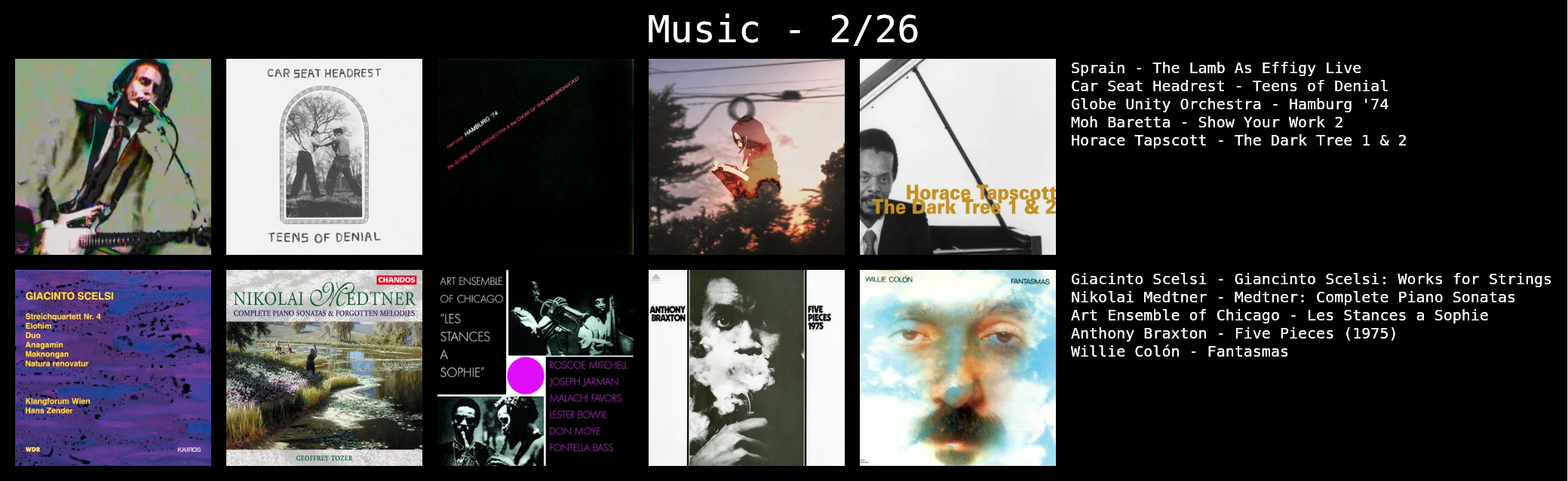
An interesting month. For much of it I was consumed with my own demonic unwillingness to live; you know, lying in bed all day lamenting being. I am thankfully out of that, although I have less music to speak of so glowingly as I did last month. Nevertheless, many interesting things.
Sprain - The Lamb As Effigy (Live)
Alex Kent is a rather divisive figure in music. His music touches on many themes of contemporary life, queer alienation, self-hatred and anger, the doom of all things that one could expect out of a bisexual Christian. It is, in essence, a sort of music of the self-death. I listened to Lamb Live at a real low point: I had barely slept, I was massively depressed, not wanting to go to school at all, not wanting to do much of anything. I watched it with two dear friends of mine and in it I found the exact sort of solace I was looking for via the exoricism hidden within; the most violent headache of my life came upon me after finishing it. The untitled track, what would come to be the Shearling record, is here taken to such massive lengths, Alex Kent taking his suit off, reflecting the utter mania o his music with every last movement, as he does on God Or Whatever You Call It, speaking to the audience from this stance of total madness, having truly lost the plot. He asks, "what's so funny" right after someone laughs, presumably because they did not know how to react, and I can't blame them. At the end of it all, Alex entirely drops the facade, giving a warm genuine thanks to the people for being there, and it is something to behold.
The heights of love, the lows of hate, all of it is here, in the riffage, in the organ work, in his piano playing, in the interplay with the rest of the band, in the incredible way this was shot that turns into something akin to a surreal analog horror movie. I started to feel cleaner after this, began to really recollect myself in the truest sense of all that means, and for that I am grateful to Kent.. but at the same time, do proceed with caution. It is a violent, all consuming listen, one you're likely never to forget for all that it is. It has really confirmed to me that I am different from how I was when I was younger; from whence I came a vile wretch, I was angry in the way only young men could be, but I was also hateful towards myself, a bigger hate that birthed the defeatism that made it so that I did not have the drive to destroy the entire world around me. What Kent makes is an homage to this hatred, signs to the embrace of it being the escape out of it, and for that I do love it, but I have become a creature of love much more so than I used to be.
Car Seat Headrest - Teens Of Denial
Will Toledo had an amazing talent for communicating a sort of angst that I think best conforms to the queer teenage experience. Before, I never found myself particularly connecting to his style because I often found it a bit too clever and a little grating (like on Twin Fantasy) but Teens Of Denial hits the right spot for me for the simple reason that it is, relatively speaking, stripped down, and it is an album where he writes many of his most straight ahead power pop/indie rock anthems, a style I found much easier to grasp onto. Teens Of Denial has a lot of great songs, the first three songs are all very good in particular, but I would like to give particular praise to Drunk Drivers/Killer Whales which has rather quickly become one of my favourite songs ever.
I saw this song elsewhere be described as a perfect encapsulation of after party depression, and that is certainly a valid way to see it, but I am a bit more inclined (as I am the polar opposite of a party person) to view it through a more continuous existential lens of extensive lamentation, a sorrow predicated on unfulfilled expectations, of the world not going the route you hoped or wanted it to. That's why the line "get out of the car and start to walk is so affecting.. it's a wakeup call to what really matters to you, and for that I am grateful for it as it has helped me get through some rough times lately.
Globe Unity Orchestra - Hamburg '74
Been doing a dive into the German FMP label, slowly but surely working through all the stuff on there. This very much stuck out to me because, not only is the lineup amazing (Schlippenbach, Bailey, Brotzmann, Schoof, Evan Parker), but there is a very interesting addition on top of the big band free jazz arrangement they have going on: the choir. The choir affords this record something very unique, a sort of surrealist soundscape the result. I don't have particularly much to say about this one other than you should absolutely listen.
Moh Baretta - Show Your Work 2
A brilliant tape, this; I'm surprised it took me so long to get to it and I don't know why I didn't listen to it when it came out.. I suppose it was because it was at the very tail end of last year, a time of reflection for me more than anything where I was trying to reason through all the madness of life, and it passed me by. Now that I've come back to it, I can safely say that this is a tape for our age, full to the brim with really fun production quirks and a conglomeration of wonderful addictive styles. Moh Baretta makes music that is densely replayable and everything on this album is that, the free car music influence REALLY shining through in particular, a sound I'd been wanting him to go down further for a while. Such fun stuff, this, don't let it pass you by.
Horace Tapscott - The Dark Tree 1 & 2
Horace Tapscott was a brilliant musician by all regards. The man helped compose for the debut Sonny Criss album, one of those real hidden gem things that starts off with one of the greatest jazz songs ever, Sonny's Dream, where the aforementioned Sonny gives a performance for the ages on his saxophone, one of those ultimate reaffirmations of the glory of jazz. Ancestral Echoes is similarly brilliant as are so many of his other works, well and truly an all-time consistent bandleader. This is just another part in the tale of that wherein he's playing with a quartet, and the interesting thing about it is that the clarinet of John Carter is given a primary role. The band plays all these songs with the same sort of philosophy of hypnosis that carries itself through some of Horace's other work via the simultaneous stasis and lack thereof of these songs. It's jazz, come on, what's not to love? I love jazz very dearly and effectively all of it does a lot for me and this is no exception.
Giacinto Scelsi - Works For Strings
Music from the pits of hell. Scelsi was dedicated to a sort of spiritual out look that I've yet to look into, but if the music is anything to go by, there's a struggle within, a reconciliation with the horror of the world a la Buddha that makes the music really captivating, not to mention the fact that Scelsi is a master of getting a lot out of a little.. all these pieces are so strangely constant and haunting in that stasis, it feels as though the strings are screaming out for relief from their pain of being. Remarkable listening experience.
Nikolai Medtner - Complete Piano Sonatas
I'd come into contact with Medtner's music years ago courtesy of a friend who helped me get into classical music at large, the guy who introduced me to impressionism in particular as well as Bill Evans (he was also a major jazzhead) and Medtner always seemed interesting to me but I never really went all in with him until now. I distinctly recall him saying something along the lines of, "Scriabin is French Russian, Medtner is German Russian and Rachmaninoff is Russian Russian."
Humor aside, the comment does have quite a bit of truth to it. Medtner more than anything was a master of form and progression, still thoroughly entrenched in late romantic idioms but stretching them out into the most interesting and exciting possible variations of themselves, and all his piano work all reflects the same approach. It's a very consistent four hours of piano music and I would recommend it for all.
Art Ensemble Of Chicago - Les Stances A Sophie
Theme De Yoyo is one of the greatest jazz songs ever. THe pulsating bass rhythm that never shifts for the entire duration of the song gives it an undertone of funkiness, and the vocals that come in on top as well only add to the immense groove at hand, the power of which is accentuated all the more by the free jazz madness these boys get to. The Art Ensemble Of Chicago got up to some very interesting things in their time, variations and combinations of jazz hitherto unseen and in this, we see one of the greatest examples of that. Worth listening to just for that opener alone.
Anthony Braxton - Five Pieces (1975)
I have a deep admiration for the body of work and constant experimentation that Anthony Braxton got up to throughout all his life. Not all of it hits for me (I found Saxophone Improvisations Series F a painful bore) but when he hits, he has this strange capacity for intellectual stimulation more than anything, his songs develop in such interesting ways and create a sort of very specific nocturnal atmosphere as well. I also very much recommend New York, Fall, 1974 if you want to hear more of this style, it was the album right after and it carries much of the same stylistic ethos across. the 17 minute long track and You Stepped Into A Dream are highlights.
Willie Colón - Fantasmas
Oh Qué Será? Moving on.
No, but really. What are you even supposed to say about the heavenly glory of salsa music, this deeply culturally specific expression that I am foreign to and yet simultaneously feel as though has been with me my entire life, the rebellion thereof, the love, the grooves, the joy that it gives me. Oh Qué Será? is endlessly replayable for this and many other reasons, and I am very quickly developing an intense obsession with salsa music because of how good Wilie Colón was, and Hector Lavoe also, although I need to keep diving in to the depths of what it all has to offer. It is reminding me of why I once loved soul so much I considered the music to be an intrinsic aspect of my identity, music of love that it has always been and this makes me feel much the same.
That's all for now. February was a bit of a rough time, but I'm sure the next month will be quite a lot better.