The Role Of Art In Resistance: Palestine, Pluralism And Existential Crises
I listen to a lot of Arab music, I made it a sort of personal project of mine to dig into it extensively. I am Arab but in truth, I've had a lot of very conflicting feelings about my natural identity for a long time. It took me a long time to get to a point where I not only felt comfortable accepting and expressing it but engaging with it in an artistic capacity.
For context, I grew up and as of time of writing continue to live in an uberconservative part of Algeria. I am queer, not a Muslim (though I have nothing against people who are) and am by nature of course very progressive. It is a rather hellish environment, one in which the most insane hateful delusional conspiratorial sentiments get passed around on the regular. Everything is a Jewish plot to destroy Arabs, the west is evil and our religion inherently makes us superior to all others, everything that isn't Muslim can be readily neglected because Allah won't be on their side on the day of judgement.
Now.. I don't subscribe to that mode of thought as I said and as will become rather evident soon. In truth, I don't entirely understand why the indoctrination never worked on me but I came out rather odd in comparison to all my peers. Not to toot my own horn as I'm rather incapable in a lot of ways (a lot of people where I live are somewhat forced into the real world far quicker than I was which I somewhat avoided by merit of being a bit academically overachieving) but I'm more media literate than most, and yet I was ignorant to the genuinely beautiful and profound history of Arab art.
Said ignorance was a bit willful in a sense. I was bitter, as a lot of ex-religious people tend to be, I had a definitional angry atheist phase where I thought religion was the root of all evil. I don't think in such reductive terms anymore but I don't blame myself for having thought that back then as the place I live in, if you don't conform to it's expectations, will turn you resentful through the extent of it's many rejections.
What has helped me especially in recent times heal from what a dear friend of mine referred to rather ingeniously as cultural dysphoria is exploring the rich musical history of the Arab world. What I've come to realise are a few things: for one, in the 20th century there arose a rich series of musical movements from different parts of the Arab world, all of which expressed their pride in their identity in different ways. So far, I've explored a lot of Lebanese music as that country seems to have a handle on art like no other, as well as things from my home country of Algeria.
Indelible is the mark of Palestine on the thematic undertones of a lot of this music. It is of course but one aspect as these artists were expressing their grief at the wartorn nature of the Arab world on the whole, a part of the world that seems perpetually cursed to revel in bloodlettings, conflicts arise because of conflicting interests by those who care not for the wishes of the common people, although often are the wishes of the common people not the best either as in the past 50 years the radical Islamist and uberconservative sentiments I described as surrounding me have become mainstream. Alas, it is not as though ignorance is a core part of the Arab experience but dealing with the ignorance of those around you very much is.
Mention Palestine around an Arab and you're likely to get a series of sentiments that are often extremely offensive in one way or another. It doesn't have to be that they're on their side either; the other day my sister-in-law expressed her dismay at a perceived Algerian backing of Palestine saying such things bring only trouble but in truth, I doubt the children being bombed particularly feel that Maghrebi love reaching them. On the other end, also common, perhaps more so, is the perception that everything wrong with the world is the result of a Zionist Jewish Freemason conspiracy to usurp the umma, and that is equally asinine and ridiculous. Anecdotally once more a friend of mine brought my attention to an obscure series on Youtube I found positively revolting because of the stupidity of the claims expressed, multiple episodes of which focus on alternative subculture and claim that emo and metal are working to depress young people and lead them down a path of depression and to make them drug addicts and commit suicide, moral panic 101. It led me to an interview which is stuck in my mind which thankfully our hilarious friends at Memri TV who actually translate things very well did just that for it.
I suppose I understand why someone would come to the conclusion that these are devil worshippers if they're only looking at them and not hearing what they're saying, the guy with the beard has a thing of shouting quite a lot and comes off extremely aggressive but what he's actually saying is absolutely true. In short, he says that metal is an artform full of depth, that he is experessing himself as he wants to and that the music is nuanced, in which is expressed the full breadth of the human experience, that the music can be politically insightful or philosophical or profound, and if you know anything about metal, you know this to be as true as anything.
The man in the suit is a knob but he comes off as more presentable, he doesn't have as much of an ogre look so he can get away with just saying horrid things. He says that he thinks metal is a moral and cultural abomination sent to Egypt and funded by Israel, a disease and rot at the core of their society, that the music is degenerate and the people who attend metal shows themselves are drug addicted promiscuous devil worshipping lunatics and the Israeli plotbr is to destroy the pure Islamic core of the Arab world so that they may control the world. The thing this obviously neglects is the very simple fact that both of the musicians they brought on are Muslims, though he snidely disregards that when they state it in very obvious terms in favor of keeping his bigotry in tact.
Truth be told, they could've obviously conducted themselves better, they're extremely confrontational but that's understandable if you know anything about the cultural backdrop of this as alternative subcultures aren't exactly widely accepted in the Arab world, and I would also get extremely annoyed if a seemingly presentable yet actually extremist asshole in a suit was condescending to me in such a manner. The reason I bring this all up is because the irony is that metal is often extremely political and that metal musicians tend to be more aware and willing to spread important messages through their music than most, and the aggressive, exciting manner in which they express that only works to enhance the messaging.
Music is universal and important sentiments can be expressed through all mediums but there's an unfortuante current of anti-intellectualism across the Arab world that leads to things like this. It's a shame because there's a rich cultural lineage that's open to taking influences from different places, which brings me to someone very special: Fairuz.
Words fail to describe the ubiquity of the figure that Fairuz became during her musical epoch. Perhaps the singular most talented female singer in modern music, she was in a sense the Arab Nina Simone, though that is a sentiment that is reductive to both her as well as in truth how unique an artist Nina was. It would be accurate to draw a comparison though because of what the two did in their respective lanes; Fairuz, like Simone, with the help of her husband Assi and brother-in-law Mansour and later on her son Ziad, broke boundaries in her lane, reinterpreting the folk tradition of her people into a new style, her sound often transcending genres, the Rahbani brothers were ingenius composers and their masterworks are really incredible, drawing from the western classical music tradition but expressing quintessentially Arab sentiments, then later on Ziad would adapt her voice to jazzy, funky works. Really, no words of mine can express the power of some of her best songs, so I will link a few here to give a taste of the power of Fairuz and what made her so as a figure.
The thing that I found most fascinating of all about Fairuz is that she was a Christian. The entirety of the Rahbani family was, in fact, and Ziad is an atheist and communist. Some of the most foundational art of the Arabic cultural canon of the modern era is not Muslim, and in the literary realm this extends too, because although a lot of writers were Muslims, there was a current of those who weren't.
In the 20th century the artistic movement that Lebanon witnessed in music was really proceeded by a literary one based in countries out of Lebanon which I haven't properly interacted with on my own but I did take a class on it. There were poets and writers that were influential to this, the most famous ones are probably Khalil Gibran and Mikhail Naimy, and both of them were Christians too! Khalil Gibran was a Maronite Christian and Mikhail Naimy was Greek Orthodox, and Fairuz herself was born to a Syriac Orthodox and Maronite family but then converted to Greek Orthodoxy. What does it say that some of the most interesting art that has been gifted to us courtesy of the Arabic language that is contemporary, interesting and relevant was delivered by non-Muslims? Arab identity and Muslim identtiy are not the same even if for most Arabs they intersect.
Of course, that's not to say Christians owned Arab art by any stretch, not even in this movement which was but one scene in it's own right. This brings me to another extremely relevant figure, Mahmoud Darwish.
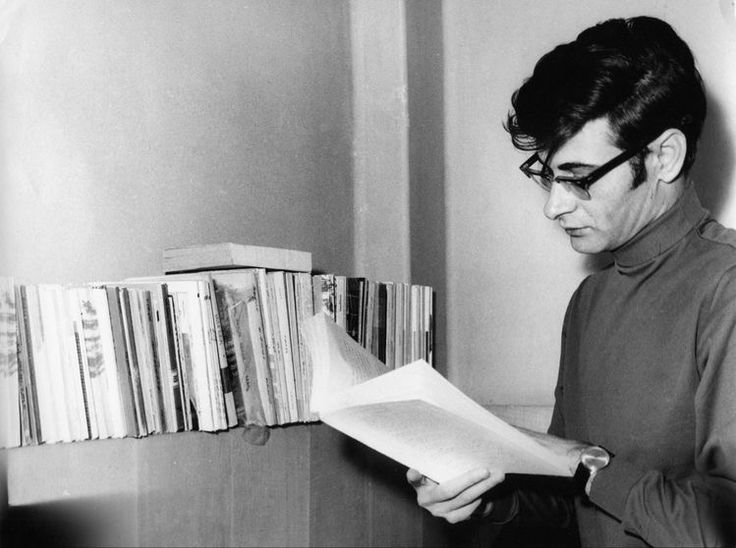
Mahmoud Darwish was Palestine's national poet in a sense, probably their most famous one and behind many a great work that expressed the plight of his people as well the plight of the modern Arab, so influential he wrote the Palestinian declaration of independence that was declared in Algiers, coincidentally, by Yasser Arafat himself, the most famous of all Palestinian resistance leaders.
The funny thing is that Mahmoud Darwish was a Muslim but his work was so influential that many of the aforementioned Christian and otherwise musical artists interpreted his work and put his poems to music, no case of which in my opinion more profound than when Khaled Al-Habr put his incredible poem Ahmad El Zaatar to song.
I wrote a review here of the self-titled Khaled Al-Habr record that first featured this genuinely jaw-dropping song on it, and the amazing thing is, the arrangements were done by the one and only Ziad Rahbani, the aforementioned atheist communist son of Fairuz. Ziad also arranged Ferkat Al Ard's first album, Oghneya, and their bandleader Issam Hajali is a Muslim, so what gives?
This brings me to a rather different but somewhat parallel situation to the one in the Mashriq happening in the Maghreb, specifically in my home country of Algeria with rai music, or rather, the rai music movement that really gathered traction around the 90s that birthed what I refer to as pop rai.
There were three artists essential to this, first being Cheb Khaled, easily the most famous Algerian artist on earth, a rather iconic moustachio'd Hawaiian shirt wearing man who looks less like a rockstar and more like my dad, Faudel who looks less like a rockstar and more like my brother with his slick clean cut and dress and Rachid Taha who actually looks like a rockstar, long flowing hair and punk influence radiating off most things he ever did, he was the one who's picture was the first in this post.
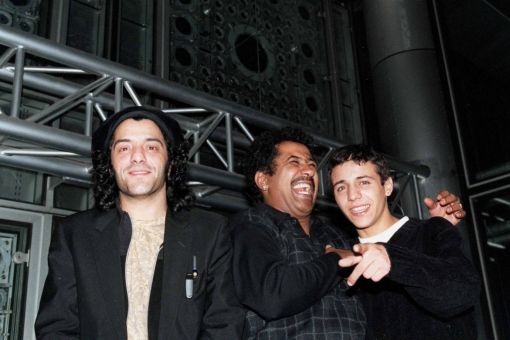
I have to mention the fact that Rachid Taha passed away in 2018 and it saddens me greatly that I took so long to find his art because he genuinely changed my conception of what an Algerian could look and act like. The way he sauntered around on stage, the way he dressed and acted and carried himself with rockstar swagger was one of a kind. Rest in peace, habibi.
That said, these three were at the forefront of their own musical Arab movement but it took a rather different form to the Lebanese music I was speaking of earlier as while those artists, although they of course often dabbled in being pop artists, had a literary and dense aspect to them often, as there was a lot to analyse and dig into with the work of someone like Khaled Al-Habr or Issam Hajali but here.. these three just made pop music.
I mean, really, pop rai was just trip hop and funk and some traditional Arab folk instruments like the oud and the sorts of percussion they'd use and those everpresent string sections and sometimes even house and other sorts of electronic music mashed into this on paper kitsch yet weirdly still evocative and one of a kind sound and style. Most of their songs weren't hiding dense lyricism, no, they were accessible to the common people of Algeria, dance music and folk songs to sing and put on the aux whenever you're given it.
The absolute height of this was the live concert in 1998 Paris that was recorded on the 1,2,3 Soleils live albun. This live album and the concert film that was recorded too accompanying it was so good it made me love my country again.. sorta.
I expressed my adorance of this thing here in more depth but suffice to say, that night in Paris was one of validation, of self-expression and the willingness to accept a core aspect of one-self while still moving on, because although they are playing traditional Algerian music, it's in Paris, and it's not really all Algerian traditional music, but they make it feel like it's Algerian despite that, they mix and match in this most perfect of ways different aspects of the pop landscape at the time in to this incredible smorgasbord that is Maghrebi to the core.
There's a link between these three and the Lebanese I mentioned earlier, and that link is the sense of pluralism and willingness to accept differences in the name of something greater than whatever rigid idea of what being Arab meant, that it is not a contradiction to be Arab but also French or Christian or what have you at the same time.
Rachid Taha is especially exemplary of this because in his own music he incorporated heavy rock influences later on, certain albums of his like Made In Medina or Tékitoi take so much from the alternative rock playbook, hell, Brian Eno is on the latter. That Brian Eno, the one who produced the Berlin trilogy and many of Talking Heads' best albums, the one who defined ambient as a genre.
And so I must return to the interview at the start of this and the connection that really ties all of this together. As I write this, there are thousands dying in Gaza by the hand of an illegitimate colonial settler state with a fascistic bent, and the entirety of the Arab world in decades past because of our losses and the choices of certain leaders (Gamel Abdel Nasser, looking at you) reacted in a negative way closing off different sects from one another and not allowing as much of a rich cultural exchange that should be expected of such a massive geographic area.
No matter what anyone will tell you, there are Arab atheists, Christians, Baha'is, and the diaspora no matter what anyone will tell you can accept both the identity of being from the country they currently inhabit as well as their cultural roots. There is a rich Lebanese and Algerian diaspora globally and in France, South America and plenty of other places, their cultures are maintained and strengthened by their distance because it becomes more imperative for them to hold onto it but at the same time, they brush up with the positive aspects of modernity.
This really leads me to my ultimate thesis that goes somewhat even beyond the Arab world and applies to the entire artistic landscape and cultural expression and is something the west could also learn, which is that cultural plurality through art can breed progress. In the 21st century democracies are supposed to be built on pluralism and acceptance, the difference of opinion is crucial to the modern world order and yet everywhere there seems to be a tide of extremist right wing sentiment washing over, in Europe and America in the form of neo-nazis and conventional fascists, in the Arab world in Islamist extremism. These movements not only fundamentally reject pluralism on a political level but also the pluralistic mindset with which these artists operated.
Under an Islamist view, the genius of Ziad Rahbani is negated under the weight of his views as is all of the true to life art of Christian Lebanon, and the Nazis themselves were vehemently against progressive and interesting or abstract artistic movements that are born of the same sort of attitude. This is all to say, art good art, art that accepts itself as being indicative of a specific worldview but malleable and open to shifting itself to the world, that art is resistance, and not only that, but it is also a bastion of the sort of progress that I really hope MENA finds someday.
Things are really rather bleak nowadays. Palestine keeps bleeding, always has, and most of our countries are stuck in repetitive cycles of oppression and new uncaring authoritarian regimes coming to power. The new Syrian establishment in time is likely to fall to this as their leader has a history of belonging to terrorist organisations and is in my own cynical opinion acting more moderate purely for the sake of gaining political acceptance, and Europe and The States are having an interesting time themselves. My final message, really, is to not only be open to other cultures and really interacting with them on a genuine level beyond surface level westerner fetishisation, but to talk to people who are different than you in general because it will yield incredible results for putting your own outlook into perspective in it's non-universality.
If you are passionate about art, not only keep it close to you but be intelligent about your view on it and in your analysis of it and understand that these things act as a miniature sort of resistance. Though you may not be at the helm of some revolution, you are acting in defiance of the base and despicable human instinct to be dismissive to that which does not align with your worldview. We are all guilty of this in a million different ways but recognising it and keeping it in check reasonably is more than enough.
With that said, listen to some of this music (the artists bolded), read the literature if you wish and I may see you another time.